»Dedicated to the one who saved my life,
and to the girls of the DDASS«
Eva Ionesco’s third autobiographical novel is titled „Grand Amour“ and revolves around three key themes: Eva’s love for the twenty-eight-year-old Charles Serruya; the looming intervention by the DDASS (child welfare services) and its consequences; and – still present, though of diminishing importance – her mother (or rather, her relationship with her).1
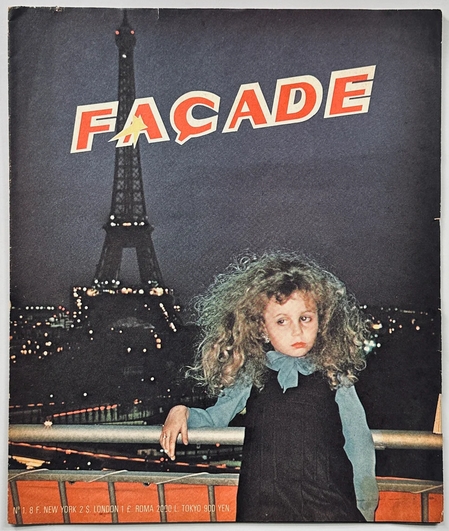
In addition to the novel, I have access to an interview published in 1978 – the year Eva turned thirteen. It appeared in an issue of the flamboyant magazine Façade, which had already featured Eva on its cover – or rather, a caricature of her – in its inaugural 1976 issue.
Cover of the first issue of *Façade*. Eva was eleven at the time – very young for the undertaking she was embarking upon. Her eyes hint at this: they are glancing toward the Eiffel Tower, the symbol of Paris. She is poised to conquer it. Or, at the very least, the Paris of the night.
The magazine was published irregularly and typically gave no further details about the date beyond the year. The 1978 issue featured a portrait of the famous surrealist painter Salvador Dalí on the cover, and Eva Ionesco was again pictured on the back cover. Inside, she spoke for herself in an interview embedded within a horoscope. She couldn’t have been much older than 13 at the time, as she was born in mid-1965, and the preparation time for an irregularly published magazine can be quite lengthy.
The interview in Façade.
Façade: [points out that Eva’s horoscope suggests she will have sexual adventures]
Eva: Yes, yes. I love making love in the car.
This could still be an allusion to the sexual encounters in the white upholstery of rock singer Gene’s blue Buick. These had occurred before Christmas 1976, when Eva was barely 11 1/2. However, it could also refer to Charles Serruya, with whom Eva was hanging out at the time, often in his car. Although she recounts several love scenes with him in detail and with enthusiasm, she makes no mention of sex in it.
Then she briefly refers to the film Maladolescenza and mentions that she had her first sexual experience there.
Further answers paint a picture of her state of mind at the time, even if she may have been coquettish or simply exaggerating – or quite simply being honest:
Façade: What interests her most about school?
Eva: Oh, school… I’ve been expelled from three high schools in the last few months, because of my clothes… and for skipping too… I’d like to go on until my Baccalaureate [high school diploma], because you can’t show your ass your whole life. [A reference to her nude photos, and that she can’t make a living from them.]
Façade: [addresses her about her „nervousness“]
Eva: Yes, I’m very nervous. Yesterday, when I got home at seven in the morning, I had a fight with Mom. She threatened to send me to boarding school. I kicked her wax figure collection, threw the phone down, the neighbors screamed and called the police… I hid under the bed… craignos!
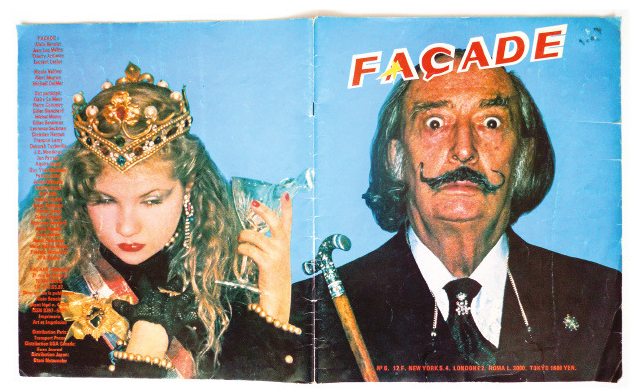
Salvador Dalí on the cover of Façade No. 8, published in 1978, with
Eva Ionesco on the back cover.
The interviewer then asked her if she ever behaved like a well-mannered girl?
Eva: When she goes to an art opening with her mother, for example, she takes off her makeup and pretends to be a petit-bourgeois woman. But she prefers to play the provocateur, walking through the metro in shorts, with all the guys following her and groping her. She might scream, but she loves it.
Perhaps she was also playing the provocateur with this answer in the same interview:
„Right now I’m in love with two boys at the same time… and then I dream about making love to one of my professors, just like that, after school!“
Then she briefly recounts a story that made the rounds in the Parisian tabloids. It was back when she was sitting with friends in front of the Café Chez Angelina, completely drunk. She took off all her clothes and urinated in front of the café. They were all thrown out and asked to leave.
The Other Sex – The Mother-Organized Sex.
As you can see, Eva claimed a great deal of freedom for herself in those years. Her mother was still there, though. In the book, the adult Eva presents the following dialogue between herself and her mother:
Irène: “Tell me everything, my girl – where do you sleep when you roam through Paris at night?”
Eva: “At my friends’ places… I’m allowed to… I go out just like them…”
At that, Irène switched on her two photo lights. Eva saw her own face in the mirrors, and behind her platinum blonde hair, blood-red sheets billowing. (p. 67).
Irène: “…a beautiful backdrop – you’re going to pose.”
Eva: “I don’t want to pose anymore; the judge and the social worker have forbidden you from taking pictures of me.”
Irène: “Then I’ll tell the social worker you’re staying overnight, and she’ll intervene. If you still want to go out… then you’ll keep posing.”
Eva: “You have no right to!” (pp. 67–68).
Irène [points to instruments lying in front of her]: “These are medical instruments for gynecological and dental procedures… You’ll play with them, stand there with your schoolbag, and play the dreamy schoolgirl, with your bottom sticking up in the air.”
Next to them were black stockings and leather gloves, which she was to put on…
Irène: After that, we’ll do a few things with the bondage rope. You’ll wrap yourself in it, you know exactly how, the rope you like so much… the one we used for the 1950s scene with… Gene and his wife Dora… where you were naked, your pussy pressed against the jukebox, and they tied you up.“
Eva continues in the book:
„That evening I posed awkwardly – naked, legs slightly spread, bag on my back, playing with the gynecological instruments, a globe and a pyramid of veined glass at my feet. After I changed and put my dress back on, Gabriel Matzneff appeared.“
[Gabriel Matzneff:] „…come, sit on my lap.“
„No…“
| Gabriel Matzneff G.M. is a very well-known French writer whose sexual predilection for young girls and boys became evident at the latest with the publication of his book Les Moins de Seize Ans [“The Under-Sixteens,” published in 1974]. He defended his sexual relationships with children in public appearances, including on television. This libertarian thinking was initially accepted in prominent literary circles and defended against objections by eminent literary critics. The prominent journalist and literary critic Bernard Pivot invited Matzneff to his programs on French public television a total of five times and also presented Les Moins de Seize Ans on Antenne 2 on September 12, 1975. In 1977, G.M. wrote an open letter demanding the release of three prisoners accused of sexual acts with 13- and 14-year-old boys and girls. The appeal was signed by some sixty prominent intellectuals, including the world-renowned existentialist philosopher Jean-Paul Sartre, his wife Simone de Beauvoir, an equally world-renowned pioneer of feminism; Gilles Deleuze, Guy Hocquenghem, Louis Aragon, Roland Barthes, and the future Minister of Culture, Jack Lang. The letter was published in the daily newspaper Le Monde [one of France’s most important]. Against the backdrop of growing public awareness of the problematic aspects of pedophilia, Matzneff found himself increasingly isolated. Nevertheless, he was still honored with a prestigious literary prize in 2013. Some members of the awarding jury later explained that they had chosen Matzneff in part because they saw him as a victim of a media blackout and public denunciation. In recognition of his literary work, the author received a kind of pension from a state fund as recently as 2019 – totaling approximately €160,000 over two decades. The payments ceased in 2020. (Source: https://en.wikipedia.org/wiki/Gabriel_Matzneff) |
»He mocked me, patted my cheeks, pinched my nipples, and pulled at a strand of my hair. „Blonde…“ I don’t remember if it was that evening or before my twelfth birthday. Gabriel invited himself over to Irène’s. He took out his stiff, pink penis, which I stroked, and surreptitiously slipped his index finger between my labia. He talked, he laughed, and she [Irène] curled up and buried herself in her pillows.«
»Gabriel often spoke of his sexual experiences with children and demanded that Irène lend me to him for group meetings.” In return, Irène expected financial support from Gabriel for her legal defense in juvenile court.«
Eva consequently found herself trapped. She feared that her mother would win her case in court. »…strangely enough, the newspapers continued to publish photos of me without anyone stopping them from selling them.” The juvenile judge had undoubtedly been manipulated.« (pp. 70-71).
Eva in New York – The Arrest
At the beginning of February 1979, when Eva was thirteen and a half, she flew to New York with her mother. There, they stayed at the famous Waldorf Astoria Hotel. The stay was paid for by an admirer of the mother (or perhaps more accurately, of Eva), whom they called “the Lord.” They knew him from a previous visit when the man still lived in London. He had published the first volume of pictures of Eva [see my Part I]. In return, he now wanted Eva to model for him in a photo shoot. But she categorically refused his request.
A short time later, Eva was surprised by her mother in the hotel room in the act of injecting herself with heroin. The mother screamed and then bombarded her daughter with questions. Following a familiar pattern, Eva flew into a rage and destroyed the television. The bill was sent to the Lord, who then withdrew his support. Eva and Irène were forced to relocate to a more modest hotel. Eva’s drug use would soon have consequences that would cut even deeper into her life.
For now, she explored a highly fashionable destination, one that seemed obvious to Eva from her own world: the nightclub Studio 54 – the New York equivalent, if you will, of the Parisian Palace, for which Eva was the mascot and where she had been a fixture since she was 12. In reality, the New York version was more of a model and a bigger rival. To some extent, it was the same celebrity bubble that frequented both venues, and that opened doors for Eva. Her first stop in New York was, logically, Edwige Belmor, bouncer at the Palace, punk band leader, model for well-known fashion brands, and Eva’s sexual partner during an intense lesbian night when Eva was 12 [see Part II]. Edwige had had a foothold in America for some time, and her face had appeared alongside Andy Warhol’s ever since Façade had brought the two together in a brilliant minimalist photo series. Eva, who had already appeared on the magazine’s cover twice, claims to have spoken with him at “Studio 54,” which she visited with Edwige.
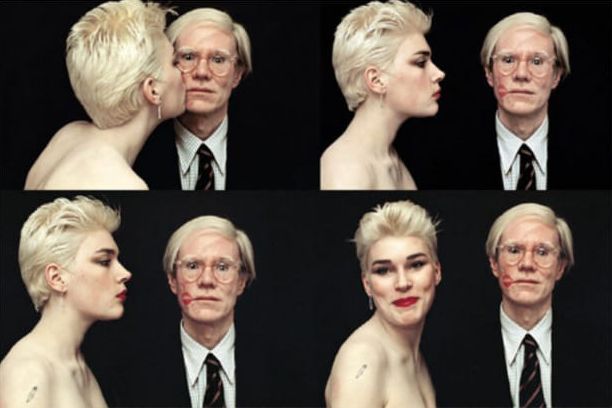
A now-famous image, concocted by Façade and first published in issue 4, 1977, shows Edwige Belmor in a kiss attack on Andy Warhol, whom Eva – guided by Edwige – met at Studio 54
in New York, then the hottest nightclub in the world.
Another parallel is interesting. According to her first book, Eva was asked by Louis Malle at the age of 10 or 11 if she wanted to play the lead role in his film Pretty Girl, and she declined. The girl who got the part was Brooke Shields. She is almost exactly the same age as Eva. Also nude photos of her had already existed, but they weren’t taken by her mother; she had merely commissioned them. She was present at the opening night of Studio 54 in 1978, escorted there by TV host Robin Leach. The studio accepted her as a kind of mascot, and she became a frequent guest, often accompanied by famous Debbie Harrie (who knows what lay behind that friendship… https://www.vogue.de/gallery/studio-54).
The next incident during Eva’s stay in New York involved drugs again. In Eva’s own words:
»The dealer lived near Avenue A. I stayed in the taxi and bought only what I needed… [Back at the hotel:] The labyrinthine corridors of the Wellington [where they were now staying] seemed endless; the room was at the very end. The harsh white light blinded me, and I shivered. As I entered, men threw me to the ground. One held a gun to my neck. „Don’t move, girl, arm up!“ Another man handcuffed me, and a third searched me until he found the white package in my shimmering handbag. Irène, drenched in sweat and pressed against the wall, watched the scene unfold, clearly pleased. „I called. You’re not allowed to take drugs.“«
»I understand that she betrayed me, sent me to prison, to social services, forever. That it was her will, my mother’s will, to hand me over to the police, that she was taking revenge.« (pp. 122-123)
Eva was taken to the police station with flashing lights and sirens, where she was questioned further. Finally, Irène managed to summon her deceased mother’s and half-sister’s husband from Chicago. As a wealthy man, he took care of the financial side. Irène was able to rebook their Air France seats for an earlier date just in time, and the two of them disappeared from the USA almost without a trace.
The Placement
Back in Paris, Irène and Eva met with Ms. Chenu, the dedicated social worker whom the reader knows from Chapter II. The three of them entered the chambers where the juvenile judge was waiting for them.
»We sat down next to each other, I sat in the middle and remained silent beyond recognition, feeling like I was swallowing a poison for which there was no antidote. The judge didn’t ask me the slightest question… while he mentioned my arrest, which was serious and, as Ms. Chenu persistently emphasized, involved drug possession.«
Irène said:
“It’s terrible, I can’t cope with my daughter right now, she’s slipping away from me, I can’t control her anymore, there’s nothing I can do, Your Honor.”
With the help of the social worker, he decided that Eva would be placed in an emergency placement at a sports training center.
[In her film “I’m Not Your (Fucking) Princess,” Violetta = Eva is placed in a juvenile detention center much earlier. The trigger there is Violetta running away at around age 11. Eva, as the filmmaker, wanted to say that she should have separated from her mother much sooner.]
She was taken by car to an estate two hours from Paris. Excursions were not permitted, nor were phone calls, except with her mother. 130/31
To avoid training, she claimed to be in pain. Those around her identified her as a non-athlete. She stated bluntly that she was experiencing withdrawal symptoms. The director ordered her to pack her suitcase immediately.
The question of her placement arose again. Mme. Chenu said that the psychologist’s report was not favorable for the mother. She was therefore ineligible for placement. Above all, she was too old [as if that was the problem with this ice-cold egocentric woman…].
And she asked if it was true that Eva had a fiancé [a fiancé – that’s what Eva called her boyfriend Charles]. She refused to answer, citing privacy concerns. Mme. Chenu agreed with her. Eva didn’t know at that moment that this now 29-year-old would make her life easier with the youth welfare office and the state, and that thanks to him, her relationship with these institutions would ultimately come to an astonishing end.
For the time being, she enjoyed life in Paris and living with him, his love for her, including the sexual kind [Eva was hardly 14 then]. Charles’s parents were away; they stayed in their apartment, then in a shared apartment with people from the Palace gang. Once, they took a trip and wanted to stay in a hotel. Eva didn’t have any identification. Charles introduced her as his sister, and they believed him. But all the while, the threat of being placed in a residential care center hung over her; she was just waiting for the decision.
»I took childlike delight in locking myself with him in his parents’ apartment; I wanted him to cherish me completely, me and my youth. The young girl I was dressed up for him; I loved admiring his rapturous gaze as he took in my body, and feeling the stirrings of his desire against my belly as dawn broke. „You are beautiful, you are my angel, I love you.“ With half-closed eyes, I dreamed of remaining like this forever, for in reality I knew no other state at a man’s side than that in which love is shared – the only thing that matters. I surrendered to his desire, the desire to possess me protected from the horror, we made passionate love. We spent long hours taking turns reading poetry to each other, we dreamed of journeys to exotic lands, and thanks to the power of redeeming love, my inner wounds healed.« (p. 139)
Then the state struck again. Forges-les-Bains was the name of the backwater just outside Paris. The accommodations were poor, and visits and holidays were forbidden. When Eva rebelled, the headmistress told her she was there because of the danger she faced with her mother and the photographs. This angered Eva because the time when her mother photographed her was definitely over. The justice system reacted too late to a danger that no longer existed. In the book, she hints at something under the term „incest“ – »It was about escaping the pornography and the scandalous, incestuous relationships my mother reveled in; she constantly reenacted the guilt and tried to find artistic meaning in the incest from which she had come. No one could give a proper answer to that, neither educators nor judges…«
The conditions in the home were precarious:
»The mental misery numbed me… The truth was, I was trapped like a rat in a cage. I was put in a room with three other children, two of whom were incontinent and one of the three defecated in bed. They had been taken from their families and were in a dangerous condition, which was obvious. The tallest child had been beaten, his limbs were bruised…« (p. 145).
Eva describes the caretakers and psychologists as cunning, tired, and irritable, and showing little compassion. Among the residents, the fear of ending up in an even worse facility had a significant impact on their behavior. Some withdrew into silence, others learned to pretend. Eva counts herself among this latter group. Lessons were in utter chaos; and Eva and the other children quickly realized that the caretakers and teachers were waging open war.
But Eva didn’t quite understand what was going on. »It was only a twenty-five-year-old educator, who was searching for himself, who put me on the right path – it was Lucien. Lucien led me into the forest. He liked my feisty spirit, which was filled with boasting and rebellion. He wanted to rebel too, and finding me mature and seductive, he kissed me and declared that he wanted me immediately. He forced me to lie down and pressed me tightly against him. I didn’t want to sleep with him, he undressed me, and I let it happen.« Eva recognized him as a potential accomplice in her escape. She no longer wanted to sleep in the room with the little ones, and besides…
»I had been in Forges for over two weeks. I fascinated Lucien. I knew much more about life than he did. An orienteering race was the perfect opportunity to escape, so I took it, and he helped me. I completed my escape alone, found the… road again, and set off on foot. Soon, a car made a U-turn, and two educators got out. Reluctantly, I had to get back into the small car. Back at the center, Lucien, cornered, had to answer for himself… which led to his immediate dismissal, as well as mine.«
She had hoped to return to Paris, but that didn’t happen; the minibus took her far away, and she ended up in a Catholic boarding school.
»…I thought I was going crazy. The headmistress asked me not to cause any trouble at her institution; I wouldn’t be there long… I tried to escape, but as soon as I approached the gates, lights came on and a dog barked. I felt that the city wasn’t far; I enjoyed the freedom and the pleasure of running away, I wanted to find Charles again. ‚Charles, Charles, Charles,‘ the girls said, laughing that I was talking in my sleep. I answered them that I thought they were ugly and fat, that they didn’t look like girls but like hams, and that one had no desire to sleep with them. They didn’t speak another word to me and avoided me, all the better… One morning I learned that I had to return to Paris, as the boarding school was taking in several young girls in very difficult circumstances. So I owed my return to the capital to these girls in ‚very difficult circumstances‘.« (p. 147-148)
They enjoyed the days together before Eva’s next placement, taking trips to the countryside; it was spring, they made love. But Eva knew that all of this was only temporary; she feared that the next confinement would be harsher. And so it was.
The mother withdraws
In late spring, Eva stood before the judge again. She took notice of her mother losing custody of her. Eva sees it this way: »…that I now belong to the French state, but that my physical self has finally escaped Irène – on this point, I have finally won.«
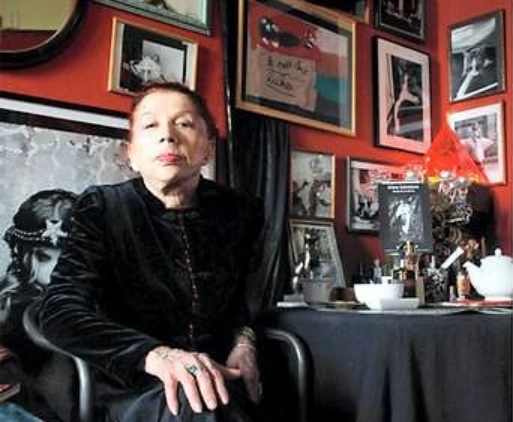
The judge placed her in a children’s home in Orsay-Ville, near Paris. She had to report there at the start of the school year in September. (p. 161) The stated purpose of this measure was, in fact, to protect Eva. But she felt that »everything was taking on the agonizing form of a punishment.« (162)
Charles gave her hope. He wanted to write Chenu a letter and tell her the truth, that they loved each other. Then he might get permission to visit Eva at the center. (p. 166)
They spent several high summer days on the Côte d’Azur with people from the gang, including, of course, Christian. They had hardly any money and slept on the beach or wherever they could find a spot. Eva gained weight from the Pain Bagnat and the Malibu.
Then she was unexpectedly stopped by the police on the street; the reason is not revealed in the book. She ran away when they asked for identification. The police were aware of the judge and the youth welfare office. They took her in a minibus to a facility surrounded by barbed wire. (p. 166)
»The center struck me as impersonal and squalid, much like hospitals, institutions, social services offices, or police stations; it was undoubtedly once again the prerogative of a few powerful people, and it was difficult not to feel the strong influence of the lowest rung of the social ladder [where she saw herself].« (pp. 171–172)
Here, the four of them shared a room. Lights out was at ten o’clock, but in return, they were entitled to forty minutes of outdoor time each week, which allowed them to visit the tobacconist or the hairdresser.
Observations and conversations with other inmates led her to reflect on her own body:
»What had actually happened to my numb, bothersome body, to this body that everyone had enjoyed so much?« Exactly, of course, there were the nude scenes, our love scenes in Maladolescenza, the censored shots of me masturbating in Spermula in front of the crew, Roman Polanski’s hands on my genitals. And… the visits from Gabriel Matzneff, the invitations from Borowczyk [a filmmaker then revered as a genius]. All the magazine covers where I appeared naked, made up, and with my legs spread – Zoom, News Reporter, the gossip magazines all over the world. As the youngest symbol of eroticism – the flesh-and-blood Lolita that I was – I couldn’t really picture their genitals against mine.« [To be honest, I’m having trouble understanding this sentence: “…I couldn’t concretely imagine her gender in comparison to my own”—What difference would it have made emotionally for the girl to concretely imagine the genitals of the viewers during her nude performances? Why and in what way would she have felt differently as a result? Clarifications that would aid our imagination and empathy could shed some light on the psychology of the girl photographed nude. Here the french original: „En temps que plus jeune emblème de l’éroticisme, la Lolita de chair et de sang, que j’étais, ne pouvait se figurer concrètement leur sexe contre le mien – j’étais une jeune fille pure.“ Translated with DeepL] (pp. 175–176)
* * *
The days in Orsay-Ville seemed endless. She couldn’t accept being dependent on the state. From the moment she was admitted, she refused to submit again to the »brutal onslaught of inquisitorial questions from the social workers and psychologists about her injuries, her sexuality, her relationship to the world, her feelings as a child-woman, as an abused victim or as a perpetrator, as a young girl. She had to »learn the art of evasion, of lying.« And then, speaking from the present of writing the book: »Now that time has passed and I am nearing my death, I realize that Charles’s name appeared with seraphic grace, so that they began to hear his first name with indulgence.« (p. 184-185).
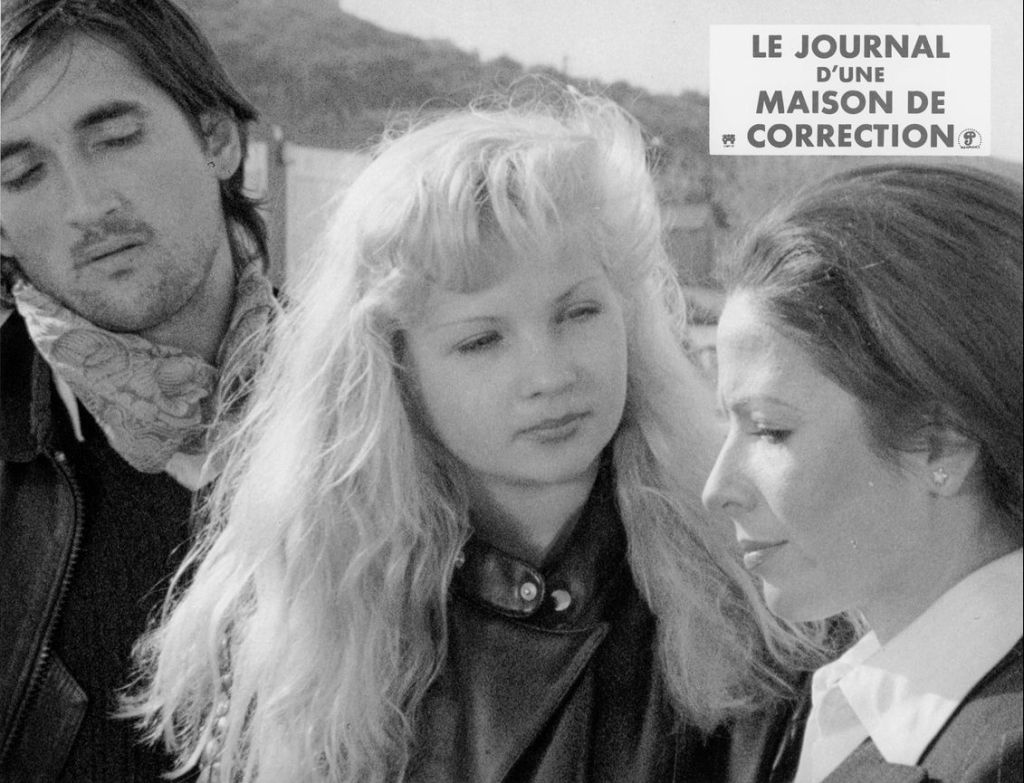
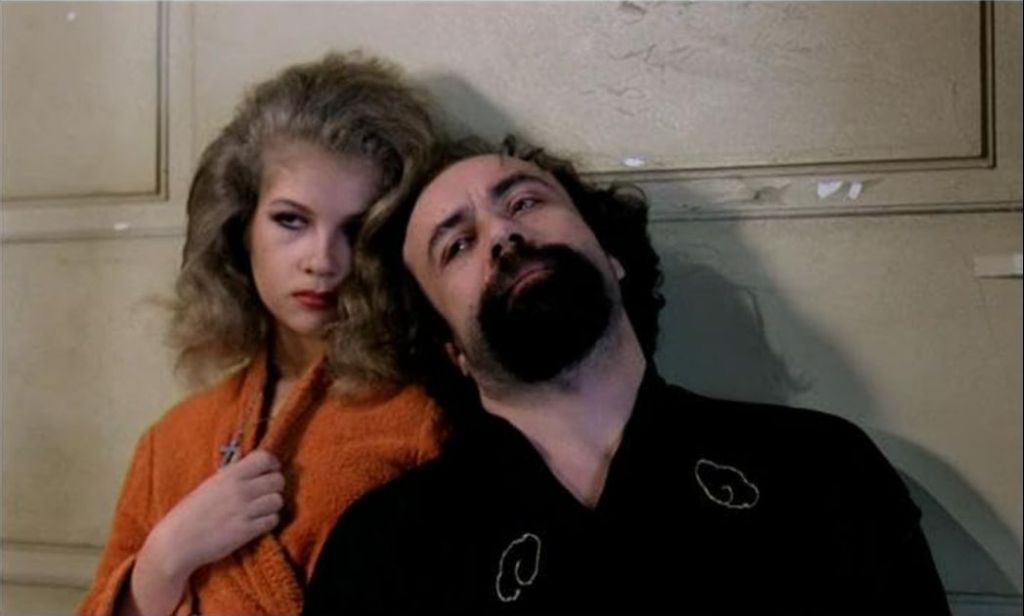
| JOURNAL D’UNE MAISON DE CORRECTION The French-Italian film was shot in 1979. Eva (14) had to ask for permission to temporarily leave the home for this purpose. The film is officially classified as a drama, but contemporary critics place it within the genre of erotic cinema or sexploitation films of the late 1970s and early 1980s. Google AI (German edition): “The film uses the setting of a girls’ reformatory primarily for provocative, risqué, and sensational scenes.” And further: “Notable is the appearance of Eva Ionesco, who was still very young at the time. As a child and teenager in France, Ionesco gained media fame through her mother’s (Irina Ionesco) highly controversial, eroticized photographs and corresponding film roles (such as in *Maladolescenza*), becoming a controversial icon of that era.” In 1982, it was released in West German theaters, where it received an FSK-18 rating due to its content (admission to the movie theater was restricted to those 18 and older). |
After another inmate told her that she herself felt better in the home than before, Eva also found that this was true, that she preferred being in the home to being with Irène. (p. 196). She received a visit from Charles in the village and was allowed to meet him there. He had obtained guardianship of her. She took him into a toilet, undressed him, and they had sex. (p. 222-228)
One evening, a fellow inmate showed her a photo magazine with Eva naked on the cover. So her mother continued to publish her photos.
»They [the law enforcement agencies and the influential writers and artists in Irène’s circle] didn’t care about my situation at all; for them, I didn’t exist – I hadn’t thought they would go that far. I felt betrayed. At the beginning of the investigation, the authorities intended to confiscate my mother’s pornography, but with the help of their famous supporters, they silenced me and closed the case.“ (p. 235)
When Eva turned fifteen, she was allowed to go on vacation with Charles. They visited Rome, Naples, and Capri.
»He undressed, pressed his body against mine, and licked the sweat from my neck, armpits, and stomach. My desire aroused him, his brown head between my breasts, which looked like two mountains. I drew out my two long, marble thighs and wrapped them around his hips, pulling him tightly against my stomach. Every slapping sound satisfied me. He lifted me into his strong arms; his softness and his scent numbed me. I panicked, surrendering to our embrace. The closer we came to ecstasy, the more visions my inner eye conjured. Between two moans, I saw Vesuvius. We tumbled over each other, making love to death. He savored our desire in my gaze.« Out of breath and surprised by the power of our lovemaking, I fell silent.
»Our connection overcame the incest, the abuse, and the violence I had suffered…« (p. 251-255)
Then Eva continued to languish in Orsay. At the beginning of March 1981, her thoughts grew increasingly dark. She had been detained for two weeks because she hadn’t contacted anyone until after 9 p.m. on a Sunday evening after returning from a weekend. She feared being imprisoned there until her eighteenth birthday, her coming of age. (p. 265) But things were about to change.
Before that, however, there was another dramatic turn of events.
Eva found herself handcuffed and unexpectedly in a cell in a disused building that looked like a hospice, but it wasn’t a prison. She had been driven there from Paris. She had lost all sense of time, which she attributed to an experience of violence or because she had taken pills – she couldn’t remember. »…maybe I tried to take my own life? Or did I pass out? Yet I still have some clear fragments of images in my mind, of me screaming and flailing about. No one told me about this episode, and in any case, even later I was never personally given a file about my life at the DDASS [Youth Welfare Office or its agencies], never.« (pp. 271-272).
* * *
Then came the release. The director of Orsay shook Charles’s hand, wished them good luck, and kissed Eva on the cheek.
And she appeared one last time at the Quai des Orfèvres. The juvenile court judge had aged; he had gained weight. He leafed through the files containing the reports – those of the psychologists, the counselors, the directors of their institutions, the police, the doctors, the social workers, the teachers, and Ms. Chenu. The judge informed her that, thanks to him, she had escaped prison in Lyon [apparently referring to this obscure event. Near Lyon, there was a juvenile detention center specifically designed for delinquent boys and girls aged 13 to 18]. Eva couldn’t remember what had happened.
What was certain now was that she could live with Charles from then on. He was her legal guardian. Irène had signed the paperwork. (pp. 272-273)
It was also certain that Eva would now receive a state pension of 1500 francs per month until she reached the age of majority at 18. In terms of purchasing power, this is equivalent to 600-700 euros today.
Eva then attended the prestigious acting school led by the renowned Patrice Chéreau.
_______________________
See below for a list of all the movies and plays in which Eva has appeared.
_______________________
See what the initial criticisms of Eva’s film roles were like…
…and how they changed from there.
Throughout her life, Eva Ionesco experienced a profound split and evolution in how her acting roles were received. The critiques can essentially be divided into two distinct phases: the highly controversial and heavily criticized roles of her childhood, and her later recognition as an established character actress in French independent cinema.
1. Childhood Roles (1970s): Controversy and Scandal
Ionesco’s early film career was inextricably linked to her role as a highly sexualized child model for her mother, the photographer Irina Ionesco.
- The Tenant (1976): Her acting debut under the direction of Roman Polański was a minor appearance. Critics primarily perceived her as part of the dark, paranoid ensemble, though this was heavily overshadowed by concurrent magazine publications.
- Maladolescenza (1977): This film, in which she performed as an 11-year-old in scenes involving nudity and simulated sex, provoked extreme reactions. In both contemporary and retrospective reviews, the film was banned in many countries or sharply condemned as highly eroticized „Eurosleaze“ cinema. While critics heavily denounced the staging of children on moral and legal grounds (the work was later categorized by some as child pornography), film-historical reviews noted that Ionesco possessed an „impressive“ and eerie screen presence as a precocious femme fatale.
2. Adult Years (1980s Onward): Establishing Herself in Independent Cinema
To distance herself from her childhood image, Ionesco completed a formal education in the 1980s at the renowned theater school of the Théâtre des Amandiers, led by Patrice Chéreau.
- Character Roles Instead of Scandal: In the following decades, she appeared in around 40 mainstream and auteur films (including L’Appartement, Eros Therapy, and La Famille Wolberg).
- Critical Reception: During this phase, media coverage shifted fundamentally. Critics increasingly praised her as a versatile and skilled character actress. She was no longer viewed as a „scandalous child,“ but rather as a stable, respected fixture of French independent and auteur cinema.
3. The Turning Point as a Director
The most reflective „critique“ of her entire acting and media biography was ultimately delivered by Ionesco herself when she moved behind the camera. Her autobiographically inspired directorial debut, My Little Princess [I’m not a f..king Princess] (2011, starring Isabelle Huppert), was highly praised by international film critics. Reviewers highlighted that she handled the deeply transgressive and traumatic material of her own childhood without sensationalist voyeurism, instead staging it with „subtle, emotional distance“ and profound psychological depth.
[The text above is generated by Google AI as answer to the question: „What kind of reviews did Eva Ionesco receive for her film roles throughout her life?“ (in German)]
_______________________
Eva Ionesco (* 18. Juli 1965 in Paris)
Filmroles (Cinema and TV)
1975 LE LOCATAIRE (THE TENANT) by Roman Polanski
1975 SPERMULA by Charles Matton
1977 MALADOLESCENZA Puppy Love by Pier Giuseppe Murgia
1977 L’AMANT DE POCHE de Bernard Queysanne
1979 Journal d’une maison de correction de Georges Cachoux
1982 MEURTRES à DOMICILE de Marc Lobet
1983 Grenouilles de Adolfo Arrieta
1984 LES NANAS de Annick Lanoë
1984 La Nuit porte-jarretelles de Virginie Thévenet
1986 Hôtel de France de Patrice Chéreau
1986 Résidence surveillée de Frédéric Compain
1986 Jeux d’artifices de Virginie Thévenet
1987 L’Amoureuse de Jacques Doillon
1989 L’ORCHESTRE ROUGE de Jacques Rouffio
1989 Monsieur de Jean-Philippe Toussaint
1992 La Sevillane de Jean-Philippe Toussaint
1992 RUPTURE(S) de Christine Citti
1992 Grand bonheur de Hervé Le Roux
1993 MONTPARNASSE-PONDICHERY de Yves Robert
1995 PULLMAN PARADIS de Michèle Rosier
1995 Encore de Pascal Bonitzer
1995 L’APPARTEMENT de Gilles Mimouni
1996 Romaine de Agnès Obadia
1996 Vive la République ! de Éric Rochant
1998 La Patinoire de Jean-Philippe Toussaint
1998 Adieu, plancher des vaches ! de Otar Iosseliani
1999 Paris, mon petit corps est bien las de ce grand monde de Françoise Prenant
2000 UN ALLER SIMPLE de Laurent Heynemann
2002 IL EST PLUS FACILE POUR UN CHAMEAU… de Valeria Bruni-Tedeschi
2002 Un homme, un vrai de Arnaud Larrieu et Jean-Marie Larrieu
2002 ÉROS THÉRAPIE de Danièle Dubroux
2003 Cette femme-là de Guillaume Nicloux
2003 QUI PERD GAGNE ! de Laurent Bénégui
2004 Quand je serai star de Patrick Mimouni
2004 LES INVISIBLES de Thierry Jousse
2005 écoute le temps de Alanté Kavaïté
2007 J’ai rêvé sous l’eau de Hormoz
2008 à l’est de moi de Bojena Harackova
2009 crime de Vincent Ostria
2009 La famille Wolberg de Axelle Ropert
2019 Es war einmal ein zweites Mal: Mitwirkung in der Miniserie als Annie Arron.
2020 L’Étreinte Als Schauspielerin übernahm sie die Rolle der Marianne.
Director
2006 La Loi de la Forét
2010 MY LITTLE PRINCESS (Arbeitstitel I`m Not a F..king Princess)
2014 La collection: Ecrire pour… la trentaine vue par des écrivains- (Miniserie)
2015 Rosa mystica Kurzfilm Regisseurin
2018 UNE JEUNESSE DORÉE de Eva Ionesco
Scriptwriter
2006 La Loi de la Forét
2010 MY LITTLE PRINCESS
2014 La collection: Ecrire pour… la trentaine vue par des écrivains- (Miniserie)
2018 UNE JEUNESSE DORÉE
Theater
Lola et toi et moi, Regie: N.Schmidt.
La voixe humaine Jean Cocteau, Regie: M.Mastor.
1987: Penthésilée & La petite Catherine de Heilbronn von Heinrich von Kleist, Regie: Pierre Romans
1987: Platanov von Anton Tschechow, Regie: Patrice Chéreau
1988: Le retour au désert von Bernard-Marie Koltès, Regie: Patrice Chéreau
1988: Le conte d’hiver von William Shakespeare, Regie: Luc Bondy
1988: Chroniques d’une fin d’après-midi von Anton Tschechow, Regie: Pierre Romans
1991: Ecrit sur l’eau von Eric Emmanuel Schmitt, Regie: Niels Arestrup
1992: Le sang des fraises von Catherine Bidaut, Regie: Daniel Pouthier
_______________
___________________________
1. Ionesco, Eva. Grand amour (French Edition). ROBERT LAFFONT/BOUQUINS/SEGHER. (Note: The above quotations are taken from the electronic edition. The page numbers given may therefore differ.)


Kommentar verfassen